
Last Updated: April 3, 2026
SAT Reading & Writing·15 min read
SAT Reading: Complete Guide to the Digital SAT Reading and Writing Section (2026)
Everything about SAT reading: format, question types, scoring, timing, and strategies for the digital SAT Reading and Writing section. Updated for 2026.
Larry Learns
Updated 
Meet Larry
Turn SAT & ACT Prep Into a Game
Take a free diagnostic, discover your score, and improve through bite-sized daily challenges.
- Discover your score in 2 minutes
- 25,000+ SAT & ACT practice questions
- Daily streaks, goals & leaderboards
Start Free Diagnostic
No credit card requiredTakes 2 minutes

Your estimated SAT
1240Goal: 1400
4001600
Free 2-minute diagnostic
Key Takeaways
- The digital SAT combines reading and writing into a single section with 54 questions in 64 minutes, split across two adaptive modules
- Each question is paired with a short passage of 25 to 150 words, a major change from the old SAT's long multi-paragraph passages
- The section is adaptive: your performance on Module 1 determines whether you get a harder or easier Module 2, which affects your scoring ceiling
- Scoring ranges from 200 to 800 and counts for exactly half of your total SAT score
- The four question domains are Craft and Structure, Information and Ideas, Standard English Conventions, and Expression of Ideas
The SAT Reading and Writing section is where most students have the biggest opportunity to raise their total score. Unlike math, where you need specific formulas and techniques, the reading section rewards a learnable set of skills: understanding passages quickly, recognizing grammar patterns, and finding evidence in text. With the right preparation, most students improve significantly.
This guide covers everything you need to know about the digital SAT reading section: the format, all four question domains, scoring, timing, strategies, and how to prepare. Whether you are taking the SAT for the first time or retaking it to improve your score, start here.
Digital SAT Reading and Writing: Format and Structure
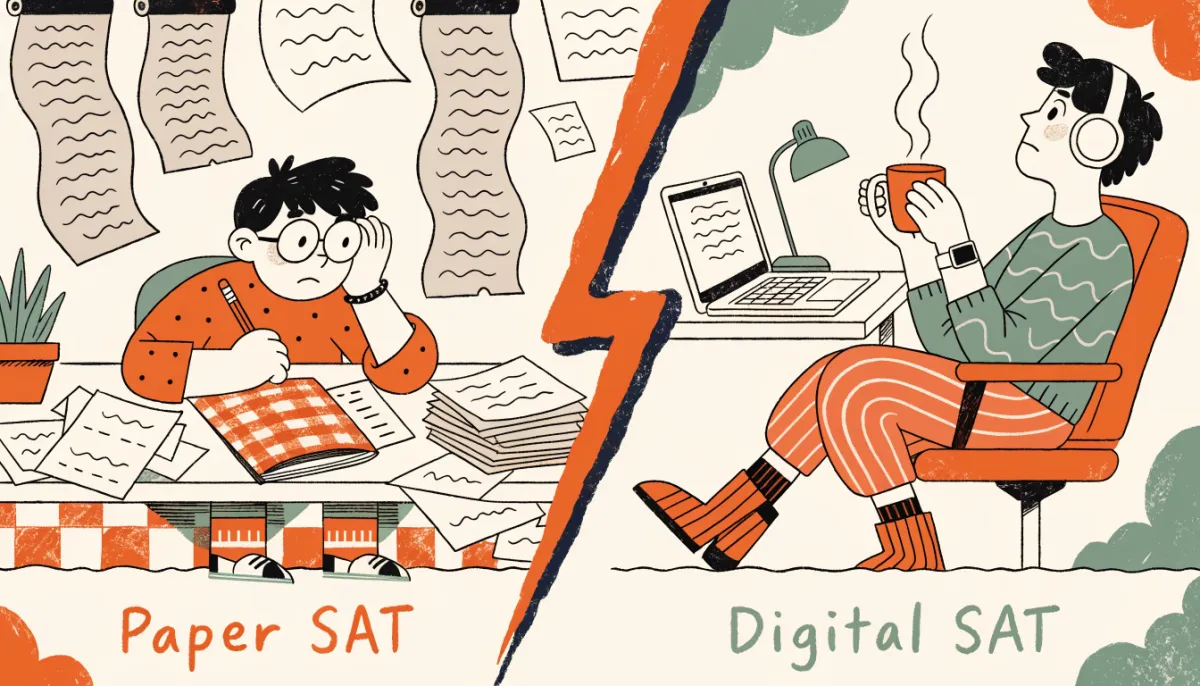
The digital SAT, launched in March 2024, completely redesigned the reading experience. Instead of long passages with multiple questions each, you now get short passages with one question per passage. Here is what the section looks like according to College Board:
The one-passage-per-question format is the most important structural change from the old SAT. You no longer need to read a 750-word passage and hold its content in your head across 10 or 11 questions. Instead, you read a short text, answer one question, and move on. For most students, this makes the section less mentally exhausting and more approachable.
How Adaptive Testing Works
The digital SAT uses multistage adaptive testing (MST). Here is how it works:
- Module 1 contains a mix of easy, medium, and hard questions. Everyone gets the same difficulty distribution.
- After you finish Module 1, the test scores your performance and assigns you to one of two Module 2 versions: a harder module (if you did well) or an easier module (if you struggled).
- Getting the harder Module 2 unlocks the full scoring range. Students who receive the harder module can score up to 800. Students who receive the easier module have a lower scoring ceiling, typically capping around 600 to 620.
This means Module 1 performance matters a lot. Doing well on Module 1 gives you access to higher scores on Module 2, even if you miss a few questions there. Focus your energy on accuracy in Module 1.
Loading practice questions...
The Four SAT Reading and Writing Question Domains
Every question on the SAT Reading and Writing section falls into one of four domains. The questions within each module are ordered by domain (Craft and Structure first, then Information and Ideas, then Standard English Conventions, then Expression of Ideas) and within each domain by difficulty (easier questions first).
1. Craft and Structure (approximately 28% of questions, ~13 to 15 questions)
These questions test your understanding of how texts are constructed. They focus on vocabulary in context, text structure and purpose, and cross-text connections.
Words in Context questions give you a short passage with a blank and ask you to choose the word that best completes the sentence based on meaning and context. These are not obscure vocabulary tests. The words are all commonly used, but you need to pick the one that fits the specific context.
Text Structure and Purpose questions ask what function a text serves: Does it introduce a counterargument? Present a finding? Provide background? You need to understand the role the passage plays rather than just its content.
Cross-Text Connections questions present two short passages and ask how they relate. One might support the other, contradict it, or address the same topic from different angles.
2. Information and Ideas (approximately 26% of questions, ~12 to 14 questions)
These questions test your ability to understand, analyze, and use information from texts and data.
Central Ideas and Details questions ask you to identify the main point of a passage or locate a specific detail that the text states. These are the most straightforward reading comprehension questions.
Command of Evidence (Textual) questions give you a claim and ask which piece of evidence from the passage best supports it. You need to evaluate which quote or detail most directly backs up the stated assertion.
Command of Evidence (Quantitative) questions pair a passage with a table, graph, or chart and ask you to use the data to support or complete a statement. You need to read both the text and the data to answer correctly.
Inferences questions ask you to draw a reasonable conclusion from the information presented. The answer is not directly stated but follows logically from what the passage says.
3. Standard English Conventions (approximately 26% of questions, ~12 to 14 questions)
These are grammar and punctuation questions. The passage contains a blank or underlined portion, and you choose the option that follows the rules of standard written English.
Topics tested:
- Subject-verb agreement
- Pronoun-antecedent agreement
- Verb tense and form
- Punctuation (commas, semicolons, colons, apostrophes, dashes)
- Sentence boundaries (fragments, run-ons, comma splices)
- Parallel structure
- Modifier placement
If you are familiar with the 15 core SAT grammar rules, you can answer these questions quickly and confidently. Grammar questions are the most predictable on the entire SAT because the rules do not change.
4. Expression of Ideas (approximately 20% of questions, ~8 to 12 questions)
These questions test your ability to revise text for clarity, effectiveness, and coherence.
Rhetorical Synthesis questions give you a set of bullet points or notes and ask you to choose the sentence that best combines or uses the information for a specific purpose (such as emphasizing a particular finding or addressing a specific audience).
Transitions questions ask you to choose the word or phrase that best connects two sentences or ideas logically. You need to understand whether the relationship is one of contrast (however, nevertheless), addition (furthermore, moreover), cause (therefore, consequently), or something else.
SAT Reading and Writing Passage Topics
The passages you encounter come from a variety of subjects. College Board draws from:
- Literature: Excerpts from novels, short stories, and poetry (classic and contemporary)
- History and social studies: Passages about economics, psychology, sociology, political science
- Science: Biology, chemistry, physics, earth science, health science
- Humanities: Art, music, philosophy, cultural commentary
You do not need background knowledge in any of these subjects. Every answer is supported by the passage or accompanying data. The variety means you will encounter unfamiliar topics, but the skills for answering are always the same: read the text, understand what it says, and choose the answer that is best supported.
SAT Reading and Writing Scoring
Your Reading and Writing score ranges from 200 to 800 and makes up exactly half of your total SAT score (the other half comes from Math). The adaptive format affects scoring in an important way.
The national average for SAT Reading and Writing is approximately 520. Because of the adaptive structure, getting the harder Module 2 is essential for scoring above about 620. This makes Module 1 accuracy your top priority on test day.
Use our score calculator to see how your practice performance translates to a scaled score.
Time Management for SAT Reading and Writing
With 32 minutes per module and 27 questions per module, you have about 71 seconds per question. That is significantly more time per question than the ACT reading section gives you, but the questions vary in difficulty, and the harder ones can eat up time if you are not careful.
Budget your time by domain
Within each module, questions are ordered by domain and difficulty. Here is a rough time allocation:
The key principle: spend less time on domains you are strong in, and bank that time for harder questions later. If grammar is your strength, you might finish those 6 to 7 questions in 4 to 5 minutes, giving you extra time for challenging inference or synthesis questions.
The 90-second rule
If you have been working on a question for 90 seconds and are stuck between two answers, pick your best option and move on. The digital SAT lets you flag questions for review, so you can come back to it at the end of the module if time permits. Never spend 2 or more minutes on a single question when there are easier points available ahead.
Strategies for Each Question Domain
For a deep dive into reading-specific strategies, see our SAT reading strategies guide. Here is a concise approach for each domain.
Craft and Structure strategies
- Words in Context: Read the full sentence, cover the blank, and predict what word belongs there before looking at the answer choices. Then match your prediction to the closest option. This prevents you from being swayed by answer choices that "sound right" but do not fit the specific context.
- Text Purpose: Ask yourself "Why did the author write this?" rather than "What does it say?" The answer should describe the function (to introduce, to challenge, to provide evidence) not the content.
- Cross-Text: Read each text separately and identify its main claim before comparing. The question usually asks about agreement, disagreement, or how one text relates to the other's argument.
Information and Ideas strategies
- Central Ideas: The main idea is what the entire passage is about, not just one sentence. Eliminate answers that are too narrow (only about one detail) or too broad (bigger than what the passage discusses).
- Command of Evidence: For textual evidence questions, match the claim in the question to a specific part of the passage. The correct evidence directly supports the claim, not loosely relates to it.
- Quantitative Evidence: Read the title and labels of the table or graph first. Then read the question. Then look at the specific data point(s) the question asks about. Do not try to understand the entire dataset before reading the question.
- Inferences: The correct inference is one small step beyond what the passage states. If an answer requires multiple assumptions, it goes too far.
Standard English Conventions strategies
- Read the full sentence before looking at the answer choices. Many grammar questions require understanding the entire sentence structure to identify the correct option.
- Identify the rule being tested. Is it subject-verb agreement? Punctuation? Verb tense? Once you know the rule, apply it.
- When in doubt, choose the simplest option. The SAT, like the ACT, favors concise, clear writing. If two options are grammatically correct, the shorter one is usually preferred.
Expression of Ideas strategies
- Transitions: Read the sentence before and the sentence after the blank. Determine the logical relationship (contrast, addition, cause/effect, example) and choose the transition that fits. "However" and "therefore" are not interchangeable, even though both connect ideas.
- Rhetorical Synthesis: Read the question stem carefully. It will tell you the specific purpose: "emphasize the study's implications" or "introduce the topic to a general audience." The correct answer matches that purpose, not just the information.

SAT Reading vs ACT Reading: Key Differences
If you are deciding between the SAT and ACT, understanding how the reading components differ is essential.
Students who dislike reading long passages under time pressure often find the digital SAT format more manageable. Students who are fast readers and prefer getting "into" a passage tend to favor the ACT. The best way to decide is to take a timed practice section of each test and compare your scores. Our SAT vs ACT comparison guide covers the full picture.
How to Prepare for SAT Reading and Writing
The SAT Reading and Writing section responds well to structured preparation. Here is a practical study plan.
1. Take a diagnostic
Start with a practice quiz to establish your baseline. Note which question domains give you the most trouble. If grammar is your weakness, you have a clear path: learn the rules. If reading comprehension is the issue, your approach will be different.
2. Master the grammar rules first
Standard English Conventions questions are the most predictable and the fastest to improve. There are roughly 15 to 20 grammar rules that appear repeatedly. Learn them systematically: subject-verb agreement, pronoun agreement, comma rules, semicolons, verb tense, parallel structure, and modifiers. Our SAT grammar rules guide covers all of them. This is where many students gain the most points in the least time.
3. Build vocabulary through reading
Words in Context questions test common words used in specific ways. The best preparation is regular reading of challenging nonfiction: news analysis, scientific articles, opinion essays, and literary criticism. Reading 15 to 20 minutes a day builds the contextual vocabulary knowledge the SAT tests. Flashcard-based vocabulary study is less effective for the digital SAT because the test focuses on usage rather than definitions.
4. Practice with official materials
College Board provides free digital SAT practice tests through Bluebook, their official testing app. These are the closest match to real test difficulty and format. Work through at least 3 to 4 full Reading and Writing sections under timed conditions. For recommended study books, see our best SAT prep books guide.
5. Review every mistake
After each practice session, go back to every question you missed and identify why you got it wrong. Was it a grammar rule you did not know? A misread passage? A vocabulary word you were unsure about? Categorize your errors so you know exactly where to focus. The students who improve the most are the ones who review errors thoroughly, not the ones who take the most practice tests.
6. Simulate test conditions
At least once before test day, take a full-length digital SAT practice test under real conditions: timed modules, no phone, no breaks between modules (you get a 10-minute break between sections). This builds endurance and ensures you know exactly what to expect. For broader SAT preparation tips, see our SAT prep tips guide.
Common Mistakes to Avoid
- Overthinking vocabulary questions. Words in Context questions are about fit, not difficulty. The answer is usually a common word used precisely. Do not second-guess a simple answer because it feels "too easy."
- Ignoring the question stem on evidence questions. Evidence questions always specify what claim you need to support. Read that claim carefully before evaluating the answer choices. Many students choose evidence that relates to the passage topic rather than evidence that specifically supports the stated claim.
- Not reading the full sentence on grammar questions. Skipping context leads to errors on agreement questions where the subject and verb are far apart. Always read the full sentence.
- Spending too long on Module 1 easy questions. The first questions in each module are the easiest. Do not overthink them. Move through them efficiently and save your time for harder questions at the end.
- Giving up on Module 2 if it feels hard. If Module 2 feels harder, that is a good sign. It means you did well on Module 1 and are now in the higher scoring track. Keep going. You can miss several questions on the harder Module 2 and still get an excellent score.
How SAT Reading and Writing Fits Into Your Total Score
Your Reading and Writing score (200 to 800) is added to your Math score (200 to 800) to produce your total SAT score (400 to 1600). Each section carries equal weight, so a 50-point improvement in Reading and Writing raises your total score by exactly 50 points.
For most students, the Reading and Writing section is the easier place to gain points because it covers a wider range of skills (some of which, like grammar, are very learnable) and because the short-passage format reduces the advantage of being a naturally fast reader.
A strong Reading and Writing score also signals strong communication skills to colleges, which matters across all majors, not just humanities. For a comprehensive approach to raising your total SAT score, see our SAT prep tips and SAT math study guide.
Frequently Asked Questions About SAT Reading
How many questions are on the SAT reading section?
The SAT Reading and Writing section has 54 questions total, split across two modules of 27 questions each. You get 32 minutes per module (64 minutes total). Each question is paired with its own short passage, so there are 54 passages as well.
Is SAT reading hard?
The SAT reading section is challenging in a different way than most students expect. The passages are short and manageable, but the questions require precise reading and careful elimination. The grammar questions are predictable once you learn the rules. The reading comprehension and evidence questions require practice to master. Most students find the digital SAT format less stressful than the old paper SAT because the short passages reduce cognitive load.
What is a good SAT reading and writing score?
The national average is approximately 520. A score of 600 or above puts you above the 70th percentile. For selective colleges, aim for 680 or higher (90th percentile). For the most competitive schools, 740 or above (97th+ percentile) is the target. Use our score calculator to see how your practice scores compare.
How is the SAT reading section scored?
Your raw score from both modules is combined and converted to a scaled score from 200 to 800 through a statistical equating process. The adaptive structure means your Module 2 difficulty affects your scoring range. Students who receive the harder Module 2 can score up to 800, while those who receive the easier Module 2 typically cap around 600 to 620. There is no penalty for wrong answers.
What is the difference between SAT reading and ACT reading?
The SAT uses short passages (25 to 150 words) with one question each and includes grammar in the same section. The ACT uses long passages (~750 words) with 9 to 10 questions each and has reading in a separate section from English. The SAT gives slightly more time per question (71 vs. 67 seconds) and is adaptive. Students who prefer shorter texts with more time tend to favor the SAT. Fast readers who like deep-diving into long passages tend to prefer the ACT.
How can I improve my SAT reading score quickly?
Focus on grammar rules first, as they are the fastest skill to learn and the most predictable on the test. Then practice evidence-based questions using official materials. For most students, learning the 15 core grammar rules and practicing 3 to 4 timed modules produces a 40 to 80 point improvement within 2 to 4 weeks. Start with a diagnostic quiz to identify your weakest areas.
Does the SAT still have a separate reading section?
No. As of the digital SAT (March 2024), reading and writing are combined into a single Reading and Writing section. The old SAT had a separate 65-minute Reading section with long passages and a separate 35-minute Writing and Language section. The digital SAT merges both into one 64-minute adaptive section with short passages.
Should I study SAT reading and writing separately or together?
Study them together because they appear in the same section on the real test. However, you can focus your practice sessions on specific domains. Spend some sessions on grammar (Standard English Conventions), others on reading comprehension (Information and Ideas), and others on full timed modules that mix everything. This targeted approach is more effective than only doing full practice tests.
#sat#reading#writing#guide#test-prep



Ready to test your knowledge?
Put what you've learned into practice with our intelligent quiz system.